
"What are we doing here"??
What to Expect From Couples Therapy
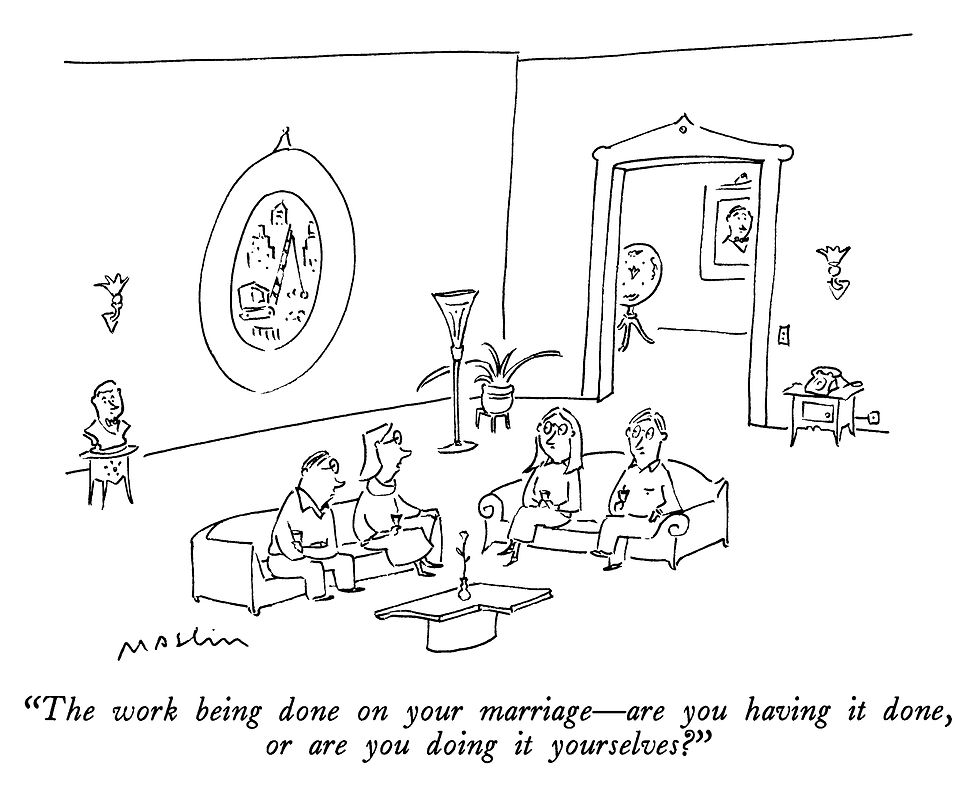
I saw this New Yorker cartoon back in the early '90s, when I was still a new therapist starting to dip my toe into the therapeutic world of couples work. The caption under this cartoon is funny, of course. One couple is referencing the process of home remodeling or construction. But underneath this tongue-in-cheek cartoon is a deeper, and more meaningful message — couples therapy is not a passive endeavor.
Whether you're a newbie at couples therapy or you've seen relationship therapists in the past, this is for you. I find that clients who come in to work with their partner on changing old patterns very often don't know what to expect or how to "do" couples therapy. We don't go to a couples therapist as we would to a massage therapist or acupuncturist and have them work on us with little or no effort on our parts. Far from it. Relationship therapy is a team sport, it involves rolling up your sleeves and facing the hard stuff.
Couples therapy doesn't work ON you, you work IN couples therapy.
This post is meant to help you get the most out of couples therapy — how to prepare for sessions, what "working on the relationship" really entails. And I add a few ideas about relationships I hope can help you prepare for the hard work of real personal (and relational) growth:
OK, Now What?
Your first task, after deciding to seek couples counseling, is to decide what you want from therapy — the kind of partner you want to become, the kind of relationship you want to build, and specifically what's working and what's not working for you anymore. In other words — what is your relationship goal?
My job as your relational therapist, like a good coach, is to help you figure that out and then help you get there. This process works to build a better understanding of yourself, your partner, and the patterns you may have gotten stuck in — and then use that understanding to break patterns that aren't healthy and learn new tools to build newer, healthier ones.
"It shouldn't be this much work!" Something I hear all the time, and my response to that is "yes, it IS work, and that's the only way real change comes about." Most deep, core pattern change is rarely easy. Building and maintaining a healthy, happy relationship takes work...but it's good work!
What It Really Takes
Real, lasting change asks something of both of you: time together, the willingness to feel uncomfortable (trying new approaches, speaking up instead of staying quiet, hearing hard feedback), and the energy to keep showing up for each other even when it's not easy. It also asks you to work on your own reactions, rather than waiting for your partner to stop doing the thing that bothers you. None of this works if one person carries the relationship alone — it's a partnership, and you can't expect one partner to carry most of the work and still get an exceptional result. This process takes both partners working on themselves and their own individual habits to create a new, better dynamic between them.
How to Get the Most from Couples Therapy Sessions
It's tempting to walk into a session and talk about whatever's freshest — the latest argument, or a shared shrug of "we don't really know what to bring up." Therapy doesn't work "on you" — you work IN the therapy. It is not a passive endeavor. Sessions go further when each of you comes in having thought about things beforehand: what you're personally working on to improve in the relationship, what you've noticed about yourself and your partner (positive or negative) since our last session, and what the next step is. A few minutes of reflection before each session pays off more than you'd expect. Once the above reflections have been shared and voiced, I can help you make sense of what has transpired and we process more around what has worked and what didn't go so well…and why.
A Few Thoughts Before You Begin Couples Therapy
● Attitude matters more than the specific action you take. Knowing what to do is often the easy part — the real work is understanding why you don't do it.
● You can't change your partner, and your partner can't change you. You can influence each other, but the fastest way to change your relationship is to become a more effective partner yourself.
● It's natural to build a case for why your partner should change. It's harder — and more useful — to focus on improving your own response.
● Trust is built the simple way: by doing what you say you'll do.
● Good communication means managing your own emotions, being clear about what you actually want, and understanding what the problem means to you — not just what happened.
● It's not what you say. It's what your partner hears.
● Grace under pressure isn't a personality trait — it comes from practice.
● Insight without action is passivity. Action without insight is thoughtless. You need both.
● A relationship with zero conflict isn't peaceful — it's dull. Growth tends to come from disagreement, not the absence of it.
And Finally...
You can't build a flourishing relationship by only fixing what's broken. It's a start, for sure. But then we roll up our sleeves and begin the hard work of changing these broken patterns and creating newer and healthier ones with newer, more relational tools. Believing change is possible is often the first step toward making it real.
"Changing one's own behavior is a much more promising strategy than insisting on change from the other." — Terry Real (founder of Relational Life Therapy)
-
Comments